Hematology Questions

Hematology Questions

اسئلة في امراض الدم محطة تدريب نحو النجاح
لا تتردد في ارسال اي سؤال او توضيح او طلب

فريقنا مستعد دائما للدعم والمساعدة

1 / 31

A 24-year-old man with G6PD deficiency presents to the emergency department with jaundice and fatigue for two days. He was diagnosed with urinary tract infection 5 days ago and completed course of antibiotics. The laboratory results show low hemoglobin, elevated lactate dehydrogenase, and indirect hyperbilirubinemia. The direct antiglobulin (Coombs) test is positive.
Which of the following medications was the patient most likely prescribed?

2 / 31

A 59-year-old man with presents to the emergency department with fever and productive cough. He has history of low back pain for the past three months. On physical examination, scattered crackles are auscultated over the right lung base. Chest X-ray reveals right lower lobe consolidation. Laboratory studies are shown in the table.


Which of the following tests will most likely confirm the underlying diagnosis?

3 / 31

A 73-year-old man with cardiomyopathy and left ventricular mural thrombus presents to the emergency department with acute confusion and generalized weakness. His medications include lisinopril, carvedilol, spironolactone, furosemide, and warfarin. Initial laboratory studies reveal INR of 7.5. A head CT demonstrates left intraparenchymal hemorrhage.
Which one of the following is the most appropriate next step in management?

4 / 31

A 29-year-old woman presents with purpuric rash on legs, which developed over the past week. She reports history of frequent epistaxis and menorrhagia. Her only regular medication is combined oral contraceptive. Examination reveals petechiae and palpable purpura on the lower extremities. Full blood count demonstrates platelets of 62 × 10⁹/L.
Which one of the following is the most likely diagnosis?

5 / 31

A 59-year-old man with hypertension, coronary artery disease, and atrial fibrillation is brought to the emergency department with dizziness and vomiting. His current medications include metoprolol, lisinopril, atorvastatin, and warfarin. A head CT reveals 2.5 cm left cerebellar hemorrhage without hydrocephalus. An initial INR is 6.7 (normal < 1.2). Which one of the following is the most appropriate next step in management?

6 / 31

A 60-year-old woman presents to the emergency department with abdominal pain and vomiting. Her medical history is significant for atrial fibrillation. Her last dose of dabigatran was 16 hours ago. The abdomen is distended with hyperactive bowel sounds and diffuse tenderness. Abdominal CT reveals small bowel obstruction. Emergency surgery is recommended. Laboratory studies are shown in the table.


What is the most appropriate next step to reverse dabigatran’s effect?

7 / 31

A previously healthy 31-year-old man presents to the clinic with 6-week history of intermittent, non-exertional chest pressure and progressive dyspnea that awakens him from sleep. Vital signs are stable. Physical examination is within normal limits. Chest X-ray demonstrates bulky mediastinal mass with tracheal deviation.
Which one of the following is the most likely diagnosis?

8 / 31

A 19-year-old man is evaluated for persistent lymphadenopathy. His family reports significant concern due to first-degree relative’s recent diagnosis of leukemia. Physical examination reveals firm, nontender, lymph node measuring 1 cm in diameter. The remainder of the examination is unremarkable.
Which lymph node location is most suspicious for malignancy in this patient?

9 / 31

A 20-year-old man with sickle cell disease presents with acute shortness of breath, pleuritic chest pain, and bilateral lower limb pain. On examination, he appears ill and distressed, with bilateral crackles on auscultation.
Which of the following is the most likely diagnosis?

10 / 31

A 22-year-old man with G6PD deficiency is evaluated at the travel clinic. He will be traveling for four weeks to regions with high transmission of malaria. His vital signs and physical examination are unremarkable.
Which one of the following medications is contraindicated in this patient?

11 / 31

A 60-year-old woman with diabetes and osteoarthritis of the hip is scheduled for elective total hip arthroplasty. Pre-operative assessment results reveal hemoglobin of 9.8 g/dL (normal 12.0-15.5 g/dL) and MCV of 74 fL (normal 80-100 fL). All other laboratory values are within normal limits.
What is the most appropriate next diagnostic step?

12 / 31

A 59-year-old woman presents to the clinic progressive fatigue, headaches, dyspnea on exertion, and occasional palpitations for three months. Her physical examination is unremarkable. A peripheral-blood smear shows hypochromic and microcytic erythrocytes. Laboratory studies are shown in the table.


Which one of the following is the most likely diagnosis?

13 / 31

A 65-year-old woman presents to the clinic with fatigue, glossodynia, and chronic diarrhea. Her past medical history includes hypothyroidism and gastrectomy. Her current medication is levothyroxine 100 mcg daily. Physical examination is unremarkable. Laboratory studies are shown in the table.


Which one of the following is the most likely diagnosis?

14 / 31

You are the emergency physician caring for 34-year-old patient involved in motor vehicle accident. The patient is intubated on arrival for hemodynamic instability and hemorrhagic shock. The trauma surgery team initiates massive transfusion protocol. The patient has received 4 units of packed red blood cells, 2 units of fresh frozen plasma, and 1 unit of platelets. Shortly, the patient develops of wide-complex bradycardia, and prolonged QT interval.
Which of the following complications of massive blood transfusion is most likely cause of this arrhythmia?

15 / 31

A 53-year-old man presents to the clinic with progressive fatigue and pruritus after hot showers. On physical examination, he has facial plethora and splenomegaly. Laboratory studies are shown in the table.
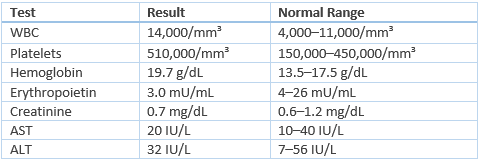

Which one of the following is the most likely diagnosis?

16 / 31

A 21-year-old man with sickle cell disease presents for right pleuritic chest pain and shortness of breath for two days. The pain radiates to his back and both legs. On examination, he has fine crackles in the right middle and lower lung zones. His vital signs show respiratory rate of 24 bpm and oxygen saturation of 91% on room air.
Which of the following is the most likely diagnosis?

17 / 31

A 32-year-old radiation physicist is brought to the emergency department two weeks after industrial accident. The patient was trapped in unshielded linear accelerator for several minutes during calibration procedure. Within four hours of the incident, he developed four episodes of emesis. Currently, he reports progressive fatigue, generalized bone pain, and gingival bleeding after brushing. Vital signs are normal. Physical examination reveals diffuse petechiae on the lower extremities.
Which one of the following is the most likely diagnosis?

18 / 31

A 65-year-old woman presents to the clinic for routine follow-up. Her medical history is significant for deep venous thrombosis diagnosed two months ago and discharged on warfarin. She reports no new symptoms, and her vital signs are stable. Physical examination is unremarkable. Laboratory testing reveals elevated INR of 7.2 and warfarin is held.
Which one of the following is the most appropriate next step in management?

19 / 31

A 27-year-old woman presents to the clinic for routine checkup visit. She has no past medical history or active symptoms. Her physical exam is unremarkable. Laboratory studies are shown in the table.


Which one of the following is the most likely cause of patient’s anemia?

20 / 31

A 19-year-old man is evaluated for painless enlarged left axillary lymph node over the past 2 weeks. His family is concerned about malignancy, because of recent diagnosis of Hodgkin lymphoma in paternal cousin. His vital signs and the remainder of his physical examination are unremarkable.
Which finding would most strongly indicate the need for biopsy?

21 / 31

A previously healthy 41-year-old woman is evaluated for 3-month history of menorrhagia and recurrent epistaxis. She reports no gingival bleeding, bruising, or hemarthroses. Physical examination is unremarkable. Laboratory studies are shown in the table.


Which one of the following is the most likely diagnosis?

22 / 31

A 24-year-old medical student presents to the clinic with purpuric rash on both lower extremities for two days. He has no medical history. Physical examination reveals non-blanching, palpable purpura on bilateral lower limbs. A peripheral blood smear shows no schistocytes or atypical cells. Laboratory results demonstrates platelet count of 31,000/mm³ (reference range: 150,000–450,000).
Which one of the following is the most likely diagnosis?

23 / 31

A 23-year-old male presents with painless neck lump for several weeks. He reports persistent, mild nonproductive cough over the past 2 weeks, as well as generalized fatigue and pruritus. Palpation of the left cervical region reveals single, firm, rubbery, non-tender lymph node measuring 2.5 cm in diameter with no overlying skin changes.
Which one of the following is the most likely diagnosis?

24 / 31

A 28-year-old female with gastric bypass surgery presents to the clinic with fatigue and dyspnea on exertion. Physical exam reveals pallor mucous membranes and conjunctiva. Peripheral blood smear demonstrates macrocytic anemia with possible pancytopenia. Laboratory studies are shown in the table.


Which one of the following is the most likely diagnosis?

25 / 31

A 71-year-old woman is hospitalized for atrial fibrillation and discharged on warfarin 5 mg daily. She returns to the clinic two months later for routine follow-up. She reports no palpitations, dyspnea, or bleeding. Vital signs are stable, and physical examination is unremarkable. Laboratory studies show INR of 6.1 (normal < 1.2) Which of the following is the most appropriate next step?

26 / 31

A 67-year-old man presents with progressive lower back pain, weight loss, and fatigue for three months. On examination, there is marked bony tenderness over the thoracic spine, ribs, and skull. Laboratory results reveal normocytic anemia. Skeletal X-rays demonstrate multiple well-defined, "punched-out" lytic lesions without associated sclerotic margins or periosteal reaction.
Which one of the following is the most likely diagnosis?

27 / 31

A 52-year-old woman presents to the clinic for joint pain and morning stiffness that began few months ago. He has well-controlled hypertension managed with hydrochlorothiazide. Physical examination reveals swelling of the proximal interphalangeal joints bilaterally. No lymphadenopathy or hepatosplenomegaly. Laboratory studies are shown in the table.


Which one of the following is the most likely cause of patient’s anemia?

28 / 31

A 33-year-old woman is brought for progressive confusion and shortness of breath over the past week. She has been increasingly drowsy and developed dyspnea at rest. Her family reports no medical history, recent illnesses, or trauma. Vital signs show sinus tachycardia. Laboratory studies are shown in the table.


Which one of the following is the most appropriate next step in management?

29 / 31

A 57-year-old man presents with fatigue and night sweats for the past 4 weeks. Vital signs are normal. Physical examination demonstrates splenomegaly palpated 4 cm below the left costal margin without peripheral lymphadenopathy. Laboratory results reveal marked leukocytosis of 140,000/μL. Peripheral blood smear shows left-shifted myeloid series with fewer than 3% blasts.
Which of the following is the most likely diagnosis?

30 / 31

A 24-year-old woman with dysfunctional uterine bleeding presents to the clinic with several-month history of progressive headache, fatigue, and recent-onset exercise intolerance. Physical examination is unremarkable. Laboratory studies are shown in the table.


Which one of the following is the most likely diagnosis?

31 / 31

A previously healthy 59-year-old man presents for evaluation of chronic constipation. He has no other symptoms. His physical examination is unremarkable. Laboratory studies are shown in the table.

Which of the following is the best next step in evaluating this patient’s anemia?

Your score is

0%

Infectious Diseases Questions
{"email":"Email address invalid","url":"Website address invalid","required":"Required field missing"}
>